
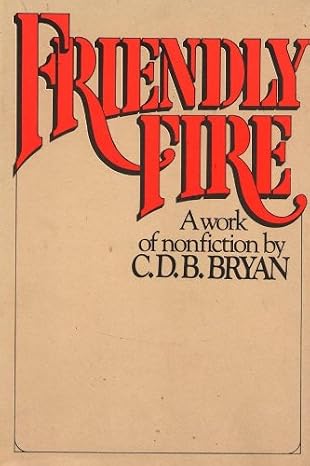
Friendly Fire
Author: C.D.B. Bryan
Release: January 1, 1975
Tagline: A work of nonfiction
Publisher: Putnam
Genre: Nonfiction, Military, History, Journalism, Activism
ASIN: B005U8DR3E
Main Character(s): Peg and Gene Mullen
Synopsis: “Drafted into the US Army, Michael Mullen left his family’s Iowa farm in September 1969 to fight for his country in Vietnam. Six months later, Michael was killed, not by the North Vietnamese, but by artillery fire from friendly forces. With the government failing to provide the precise circumstances of his death, Mullen’s devastated parents, Peg and Gene, demanded to know the truth. A year later, Peg Mullen was under FBI surveillance. In a riveting narrative that moves from the American heartland to the jungles of Vietnam, to an interview with Mullen’s battalion commander, Lt. Col. H. Norman Schwarzkopf, Bryan brings to life a military mission gone wrong, a family’s explosive confrontation with their government, and the tragedy of a nation at war with itself.”
Declassified by Agent Palmer: Middle American culture clash on full display in Vietnam era Friendly Fire
Quotes and Lines
On September 4, 1969, Sergeant (E-5) Michael Mullen left the Waterloo, Iowa airport en route to Vietnam. His last words to his anxious parents were: “Don’t worry yourself now, okay? It will all be over March first.” On March 1, 1970, Michael’s body was returned to Waterloo in a U.S. Army issue silver-gray casket, and the Mullens learned their son’s death was attributed to “nonbattle” causes.
Michael was to have been the fifth generation of his family to work the same 120-acre farm in Iowa’s Black Hawk County. Peg and Gene Mullen, his mother and father, are, in their own words, “typical working-class parents,” “good, solid citizens,” no different from others in their neighboring communities. And yet, because of their determination to discover what had really happened to their son in Vietnam, within one year of Michael’s burial they were under the surveillance of the FBI.
Peg was convinced that the Army had written Mrs. Hamilton confident she would be just a mountaineer mother of a high school dropout son and wouldn’t know enough to write a letter to anyone.
What the Army failed to take into account was the estrangement people whose sons had died in Vietnam felt toward the government, the military and, in many cases, the neighbors in their own communities.
“There’s only one side when you lose your son.” – Peg
The Mullens now knew that their son had been killed, in military terminology, by “friendly fire” and was, therefore, a “nonbattle” casualty as a result of an artillery incident officially referred to as a “misadventure” in a war which was never declared.
Howard smiled sadly. “My country right or wrong?”
“When your country’s wrong,” Gene said, “the real patriot dam well tries to do something about it!”
Still, I couldn’t help asking myself who was left in America who would be willing to read a story which in any way touched the Vietnam War. I certainly didn’t want to write one. Like everybody else, I was sick to death of hearing about Vietnam.
The temptation to create “perfect endings” was the corruption I wanted the Mullens spared. The only way I could achieve this was by finding out for them exactly what had happened to their son.
“War is a profanity. It really is. It’s terrifying. Nobody is more antiwar than an intelligent person who’s been to war.” Norm Schwarzkopf