
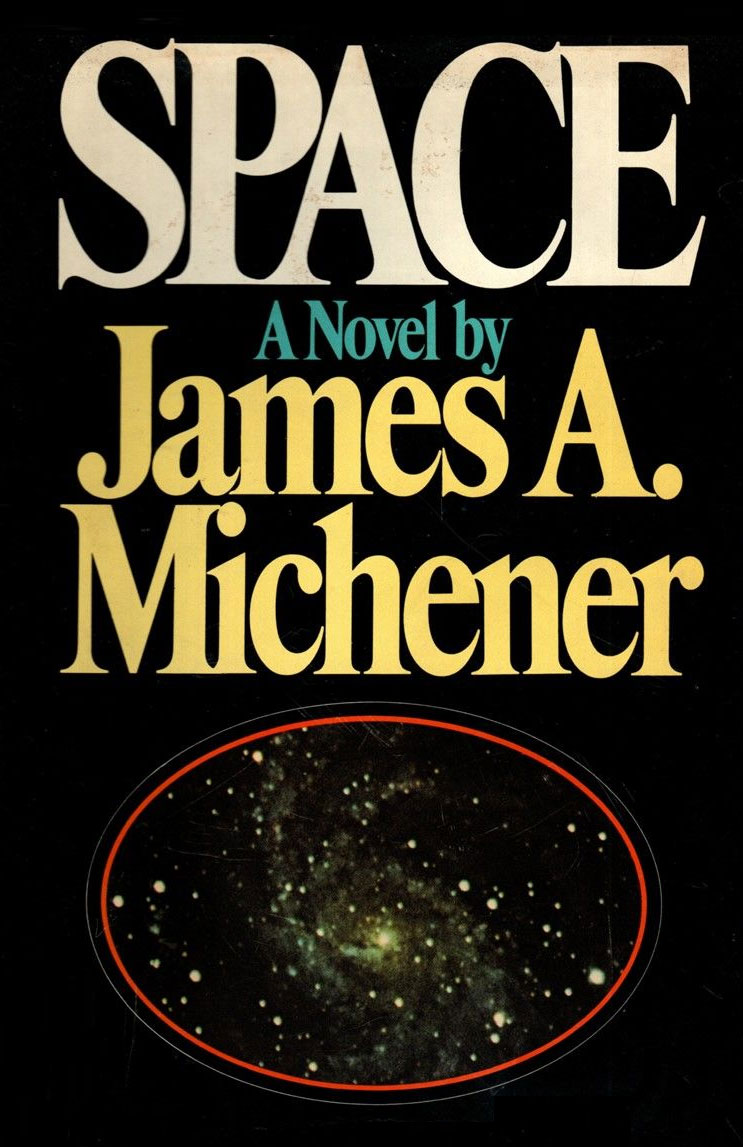
Space
Author: James A. Michener
Release: August 12, 1982
Tagline: A Novel
Publisher: Random House
Genre: Science, Fiction, Historical Fiction
ISBN-10: 0394505557
ISBN-13: 978-0394505558
Main Character(s): Dieter Kolff, Norman Grant, Randy Claggett, John Pope, Stanley Mott
Synopsis: The fictionalizes history of the United States space program and then men who helped the Moon mission succeed from NASA’s predecessor NACA to the Apollo Moon missions.
Declassified by Agent Palmer: Make Space on your shelf for Michener’s sci-fi novel
Quotes and Lines
This is a novel and to construe it as anything else would be a mistake. The Mott, Grant, Pope and Kolff families are imaginary and are based upon no real prototypes. The Solid Six group of astronauts did not exist, nor was there any Gemini 13 or Apollo 18.
Curiously, he did not bother with the bright half-Moon, for he judged correctly that this was a garish nearby phenomenon which he could always study at will; what he yearned to see were the stars, those scintillating messengers from immortal distances. So for some moments he surveyed his heavens, looking now at one high star, then another, until finally he settled upon the one which he would first see with his new glasses.
In school John Pope was not a literary boy, but like his well-educated parents he could speak in complete sentences when grappling with ideas; when playing with his peers in athletic contests he mostly grunted. But now he said aloud, ‘A human mind is limited only by the power it has at its command.’
Crampton stopped, stiffened, and in the gloom of the great tunnel, said, ‘Scientists are men who dream about doing things. Engineers do them. This was designed by engineers, built by engineers, and is run by engineers. You’re an engineer, young fellow, and you’re to be proud of it.’
‘I’m sorry,’ Mott said.
‘You thought that if an engineer was real good, he became a scientist. It’s the other way around. If you want to be an engineer but find you have ten thumbs, you become a scientist.’
‘At NACA,’ the instructor said, ‘there are no insoluble problems. Only time-consuming ones.’
Like all such experimenters in these years, whether in the backwaters of America or the remote corners of Soviet Russia, Mott lived in a world of juvenile excitement, moving from one threshold to another like a boy with a chemistry set or a new collection of maps, always wondering, speculating, making wild guesses, and striving to thrust back a little further the frontiers of knowledge.
At last both astronauts were suited and the hatch opened. Outside waited the boundless reach of space, that colorless, weightless, formless medium in which the universe exists with all its stars and galaxies and mighty conformations as yet unknown to man. How majestic it was, how inviting, and as Pope hesitated in the doorway, he was like an infant about to leave the womb which had been so pleasant and enter the world which would be so infinitely more exciting.
Stanley Mott, not wishing this argument to proceed any further, asked, ‘In a time of wildly changing mores, what can a parent do to keep his children stable?’
‘Sometimes,’ Liesl Kolff said, ‘sometimes you have to take a hammer and smash the trumpet.’
‘I think Europe may be saved because they make heroes of little, ordinary men like soccer stars and bicycle racers. They have sense enough to look at Goliath and his Philistines with suspicion. They see the merit in normality, and I think that’s why I’m so infuriated with the astronauts. They’re so little and so ordinary and so very brave.’
‘Mankind was born of matter that accreted in space. We’ve seen dramatically these past few days how things far off in space can affect us deeply. We were meant to be in space, to wrestle with it, to probe its secrets.’ – J Pope
What worried Grant in this campaign was not space, but the deplorable spiritual condition of the American people: ‘Here it is, the two hundredth anniversary of our republic and we find ourselves powerless even to mount a national birthday celebration.’ The grand designs which had been discussed since 1969 for a world fair, immense parades, exhibitions and innovative enterprises in theater, sports, publishing and television had all collapsed; a great nation, one of the gleaming hopes of mankind, was celebrating its triumphs in virtual silence, as if it were ashamed of itself.