
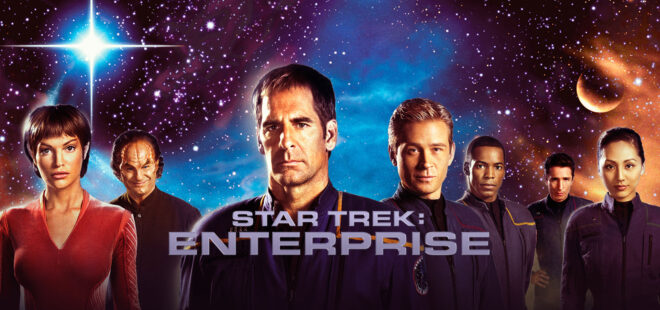
Palmer’s Trek, the unwatched frontier. These are the voyages of Agent Palmer. On his continuing mission: to explore Star Trek. To seek out its numerous series and movies. To boldly go where many fans have gone before!
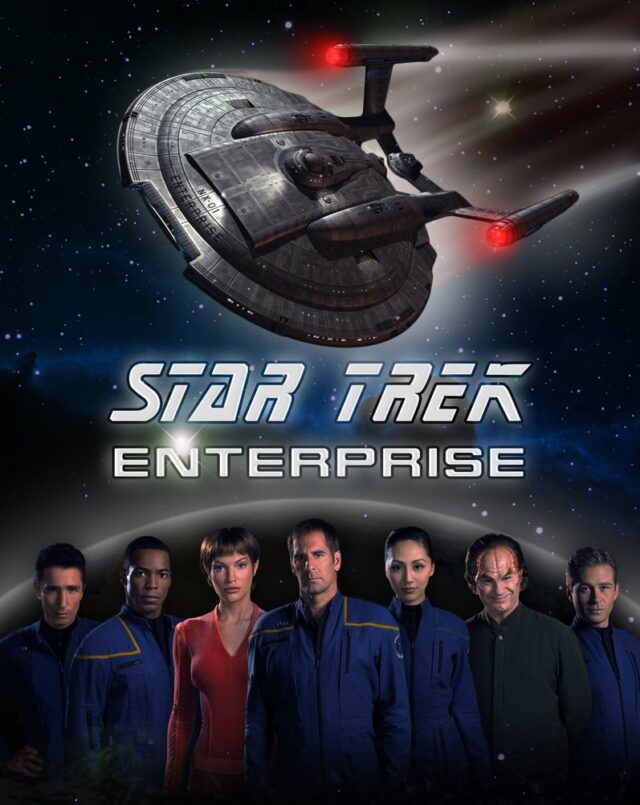
Enterprise, later Star Trek: Enterprise is a four-season prequel series for the Star Trek franchise about the adventures of the first warp five ship.
That it is a prequel should have given it a fairly blank canvas with a fixed ending point to be determined. But that’s not what Enterprise did. After trying many things in the first two seasons, it tried to find its own place within the franchise similar to The Next Generation, Deep Space Nine, and Voyager. What that means is that it did many various and similarly previously done things that just make comparisons to its three aforementioned precursors.
The show is supposed to be following the “exploration” of the first starship Enterprise (NX-01), but somehow that falls short. The series does start with the exploration that Voyager did very well. It continues with the diplomacy of The Next Generation and deals with more than enough religion and xenophobia to get direct comparisons to Deep Space Nine. The problem is that while it stands on its own in a vacuum, the series chooses to invite further comparison to its predecessors at every turn.
It seems at times that the show knows what it’s doing, but never for more than a few episodes at a time.
Was this show out of its time? It was the network replacement for Star Trek: Voyager, the third and arguably the best of the 90s television series, which left massive shoes to fill. Instead of an overlap like Deep Space Nine had with The Next Generation and Voyager had with Deep Space Nine, Enterprise was by itself. It probably competed more with the syndication of its older 90s series than anything else at the time.
The series revisits First Contact on more than one occasion. That seems more like a crutch than an obvious story beat since it’s not as “ancient history” to the time of Enterprise than it is to every other Trek series.
There’s a temporal cold war that starts early on and goes through all of the third season. The show brings threats home, as there is at least one plot to destroy Earth, and all of this is on the shoulders of Earth’s first supposedly deep space exploratory vessel.
It is important to reiterate that this all occurs before Starfleet exists. This is just Earth doing Earth-like things. It was an enjoyable show, but it just didn’t feel like Star Trek until halfway through season three, and then only occasionally until season four.
If it hadn’t been a Star Trek show, I don’t think I would have watched it at all. But I’m glad I did.
I had only starred a minimal number of episodes that were exceptional to me. In season one, there was Civilization (S1E09), Dear Doctor (S1E13), Vox Sola (S1E22), and Fallen Hero (S1E23). A single episode in season two, Judgement (S2E19), and only two in season four – Borderland (S4E04) and Observer Effect (S4E11) – got those marks from me.
The characters are not dislikeable, but making my standard favorite character list was complicated.
Phlox, the ship’s Denobulan doctor was my favorite character, followed by Charles “Trip” Tucker III, the ship’s Chief Engineer who probably has the best character development in the entire series.
Third on the list belongs to Star Trek franchise legend and only occasional character Thy’lek Shran, played by the incomparable Jeffrey Combs. He may only appear in 11 episodes, but he’s more captivating than the rest of the cast in those episodes.
Fourth on the list goes to Captain Jeffrey Archer, followed in fifth by his Science Officer, T’Pol, the first token Vulcan onboard an Earth ship.
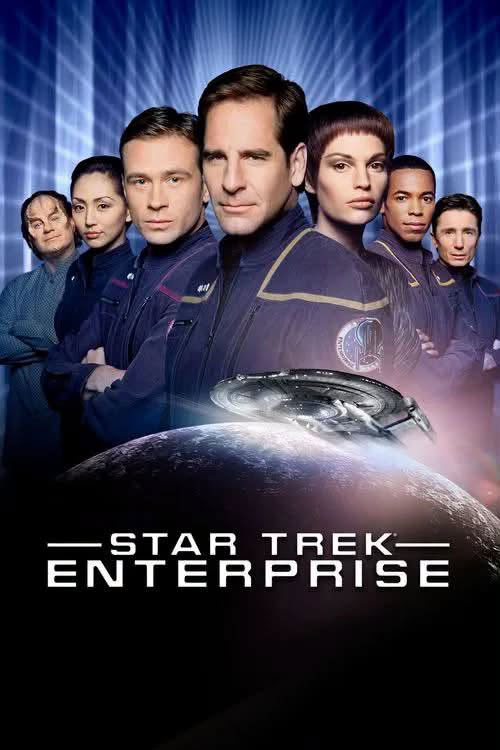
The rest of the main characters have their moments, but I don’t think I could put them in any order. Sorry to fans of Malcolm, Hoshi, or Travis. And if I forced myself for a true sixth, it would be Brent Spiner’s Dr. Arik Soong, who only appears in four episodes. Like Shran, however, he steals every episode he’s in.
It’s really hard to write about this show and not make comparisons. Perhaps that was its downfall. But the biggest change occurs after the cold open during the credits. Star Trek: Enterprise has a theme song! “Faith of the Heart” is set to a graphic backdrop of the fictional and factual technological jumps from sailing to the Wright brothers, Chuck Yeager, Apollo astronauts, the Space Shuttle, the ISS, and the future towards Warp Drive as Trek has shown us.
The show predates Firefly by a year, but doesn’t do too much to make itself different, like Firefly did. Is it possible the yoke of the franchise is holding it back? Because there are glimpses of both what made Firefly and Battlestar Galactica so successful in this series, but only glimpses.
Enterprise chose a lot of homages and hat tips to previous series and movies in the franchise with guest stars or plot points. It’s impressive when you consider that outside of parts of First Contact, most of the rest ALL happen after this show!
Watch enough of anything and you will find your own groove with it, but this thing took me over a season to get into. With the lack of explanations for the temporal time shifting cold war, which is at least simmering through the first two seasons before really kicking off, the show is actively keeping you and the characters in the dark. It almost feels like this show would be better on a rewatch, especially those first two seasons.
The third season shifts drastically in some very obvious ways not regarding plot. Not only did they find a Star Trek logo in the closet to stick on the title card, they found some drums and other instruments to add to the opening theme song as well. Plus, while they have a specific mission in the third season, it feels like they’re doing Voyager. The whole season is spent heading into an uncharted area of space where most of the non-mission episodes and even some of the B-plots feel like Voyager recycles or leftovers.
The shift in the fourth season is something that appears to be “to-be-continued” upon “to-be-continued” as if the writers were trying to use up the rest of their stories in one final season. Honestly, from season three forward, Jeffrey Combs is the savior of the series. He shines every time that we see him, much like Brent Spiner, as previously stated.
By far, the fact that the crew of the first long distance starship journey isn’t coping well with everything thrown at them has been an authentic surprise. It would have been odd if everything had been completely nominal.
I wasn’t the biggest fan of Star Trek: The Next Generation, and I do appreciate what Enterprise was trying to do. But this one is going to the bottom of the list so far. I’d really have to find a new angle to rewatch it again, instead of literally any of the other shows. If you missed this when it first aired and fancy yourself a completionist, it’s only four seasons. If need be, just watch any and every episode with Combs and Spiner. You won’t be disappointed.