
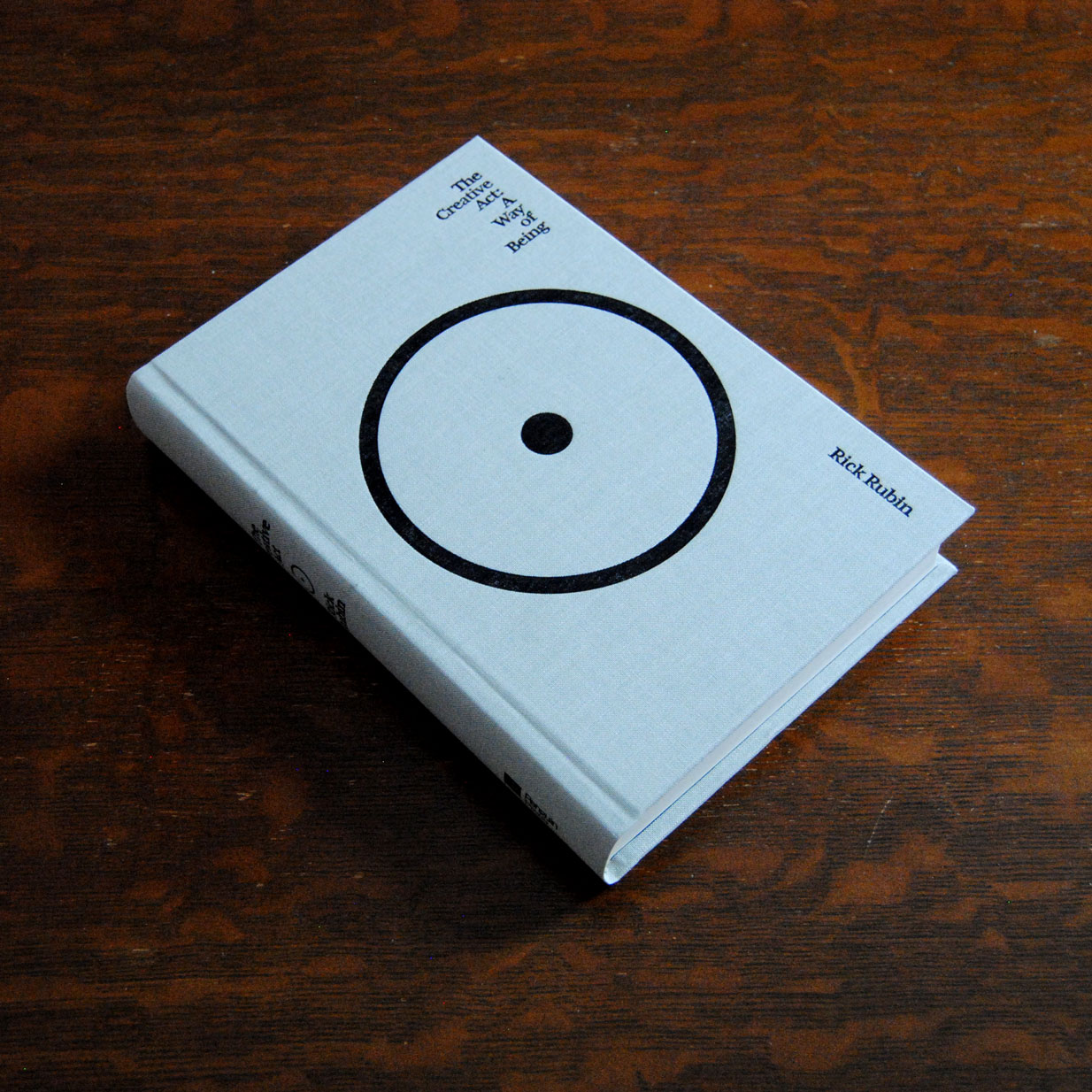
The top things I needed to read on this pass through Rubin’s The Creative Act: A Way of Being.
It’s easy to say there were 10 things I learned or was excited to read within The Creative Act. Truthfully, I made 28 notes reading it cover to cover. Perhaps at another time I would have made 18 or 48. This book is unique.
While it is, in fact, a linear read about the inspirations, actions, energies, meditations, collaborations, and many other pieces that form the act of creating art, I kept getting the feeling that this stuff could just be picked up at any time and any piece might hit you as important.
If you have writers block, if you are in the studio and are having trouble with a solo, if you are editing and can’t seem to figure something out, if you are doing anything creative or artistic at all and come to a standstill – you get the drift – this seems like the first book to pick up, open to a random page, and have it speak to you in some way.
This book also made me realize something about this blog and the podcast I do. As Rubin described each process in the book, I found that it’s all applicable to the blog or the podcast. I must conclude, with Rubin as my guide, that I am an artist.
But beyond that, having also worn hats as producer and editor on other projects, Rubin’s words resound in me as a creative soul. So let’s first get into the 10 most important takeaways for me right now as I read this book, and then I’ll get into more of why I enjoyed it. (These are displayed how they are displayed in the book.)
- Creativity is not a rare ability. It is not difficult to access. Creativity is a fundamental aspect of being human. It’s our birthright. And it’s for all of us.
- It’s helpful to view currents in the culture without feeling obligated to follow the direction of their flow.
- Sometimes disengaging
is the best way to engage. - A point of view is different from having a point.
- We are the unreliable narrators of our own experience.
- We are dealing in a magic realm.
Nobody knows why or how it works. - Do what you can
with what you have.
Nothing more is needed. - There is no wrong way to make art.
- The best work
is the work you are excited about. - Sometimes the most valuable touch a collaborator can have is not touch at all.
And it’s these things, whether they are just alone on the page or part of a story, that resonated with me. As I eluded to as we opened this review, there could be more or less and they could each be different the next time I pick up this book, even if it’s only for a few pages and not a complete reread.
I don’t know enough to equate the practices and principles in this book to any specific spiritual practices that they must relate to, outside of those he actually names, but I know enough for a vague approximation.
And if this is as far into any of that stuff as I ever get, Rubin has written a book that makes it easily digestible without dumbing it down. That may seem oxymoronic, but I promise once you read the book you’ll understand.
As I said at the outset, I would have easily argued against my being considered an artist. Maybe a musician, or a lapsed poet or author, but not an artist. Rubin’s turned me around. Any creative person in your life, no matter their trade or craft, could benefit from the ideas in this book IF for no other reason than there’s a lot in here you will know, and a lot in here you know but should still be told again.
For someone like me, who only collaborates on other people’s stuff, this is like Rick Rubin talking to me as I usually advise others. We all need a little help. This is Rick helping me. I needed it.
And if you’ve gotten this far and don’t know who Rick Rubin is, I’m about to tell you. If you do, I’m about to shock you, because he does not name drop in this book. He mentions a few artists, but not for any reason other than they prove a point. He doesn’t talk about his work with artists, and when he does, he omits names and specifics.
This is Rick Rubin! He founded Def Jam Recordings! He’s produced LL Cool J, Beastie Boys, Run-DMC, Slayer, The Cult, Public Enemy, Danzig, Red Hot Chili Peppers, Tom Petty, Johnny Cash, Nine Inch Nails, Audioslave, Weezer, Metallica, Kanye West, Eminem, Lady Gaga, Imagine Dragons, Kesha, and many many more.
He held that all back, and this is in fact a better book because of those ego omissions. He doesn’t need it; he just wants to help other artists. At least, that’s how I read the book. And it’s how I will continue to read the book when I find myself at a crossroads or stop sign.
This is a book to keep in your studio, in your writing space, in the place where you create things, or perhaps the place you go when you can’t.
This book is a friend who has been there and just wants to help you tell your story through whatever medium works for you. Rick Rubin is out to help us all. The Creative Act: A Way of Being is his way to be there for everyone who could use it.
Read the Secret File of technical information and quotes from The Creative Act.