
“Snap into a Slim Jim.”
“Stretch it out out out, Caramello.”
“Beef, it’s what’s for dinner.”
“Follow your nose.”
“They’re Grrrr-eat.”
“Trix are for kids.”
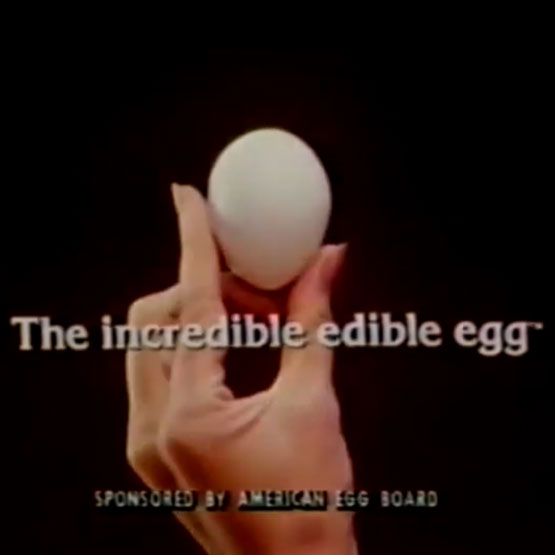
Despite all of the incredible television advertising catchphrases that still live in my millennial head, one still has a stranglehold: “The incredible, edible egg.”
Yes, yes, television was supposed to rot my generation’s collective brain, but it seems downright healthy compared to the subsequent generations’ digital diets. But that’s not the health I want to dive into.
That last slogan is not just the power of marketing. It’s the power of marketing with a tagline that you use for decades! Before my lifetime, into my early childhood and adolescence, plus through my high school and college years, the American Egg Board has consistently utilized a simple slogan – “The incredible, edible egg.”
That’s the power of marketing across decades with the same message. Economic forces and changes in health science have led to a complicated relationship with the aforementioned egg. Especially for those of us who saw the commercial that coined that catchphrase during our after school and Saturday morning cartoon blocks.
Additionally, in the intervening years and for fans of comedian Lewis Black, eggs have become bad for you, then good for you, then just the whites, then just the yolks, and then an indicator all its own of the volatility of the American economy. This is quite the journey for our on-again, off-again healthy food.

Are eggs healthier? The science isn’t conclusive, but I have a pretty good theory that eggs are not as healthy as they used to be. This has nothing to do with recent scientific studies or good cholesterol versus bad. In our race to be a more profit-driven society, quality has been one of the first sacrificial lambs. It’s not just eggs, but that’s what I’m focused on right now.
We’ve all heard stories that our great-grandparents ate two eggs every day for breakfast with bacon and toast. Odds are, back then, those eggs were healthier in the sense that they were fresher, had less additives, and were more or less closer to what would now be called “organic” than what is available in most grocery stores.
But “The Incredible, Edible Egg” campaign was launched in 1977 by the American Egg Board, because American egg farmers wanted to increase demand for eggs. The slogan I remember from my childhood, which inspired this post, can be traced all the way back to 1974. Even then, the campaign was in response to a 1973 egg controversy, or debate if you will, between the American Heart Association (AHA) and the newly created American Egg Board. Why? Because the 1973 AHA health guidelines recommended “restricting egg yolks to reduce cardiovascular risks.” This caused consumer consumption to fall.
The AHA’s anticholesterol push dropped “annual egg consumption in this country below 300 per person for the first time since 1935” according to a digitized article from the New York Times.
So, yeah, they aren’t as healthy as they were. Not much is, at least here in America. But the science of AHA’s 1973 decision has changed time and time again. I have to question the science a bit, because my theory on eggs being healthier for previous generations is based on the eggs changing, which would also change the nature of the study. You can’t go back and study our great grandparents, but you can study us. We’re not on a level playing field with generations gone by. Now, with egg manufacturers doing their best to get longer-lasting eggs and sales up with creative ad campaigns, much like “the incredible edible egg,” it’s hard to trust the healthiness of it all.
I understand some of the science of good and bad cholesterol. But I’ve not delved into the idea of which studies are based upon organic eggs and which are based on the eggs that are longer lasting due to additives.

And of course, the American Egg Board was also in battle with the new Egg Beaters, a liquid egg substitute made primarily from real egg whites. Those fell in line nicely with the AHA’s “restricting egg yolks” recommendation. There was also a National Commission on Egg Nutrition, criticism from the Federal Trade Commission, and there was even a Federal District Court proceeding.
So if you think the American Egg Board was going to take it lying down, you’ve got another thing coming. They didn’t just come up with a silly little slogan; they came up with one that had lasting power, one that they relied on for decades. This is more than we can say for the National Cattlemen’s Beef Association slogan. “Beef. It’s What’s For Dinner,” launched in 1992 and didn’t even last until the end of the decade. The tagline lives on as the National Cattlemen’s Beef Association URL: beefitswhatsfordinner.com.
I’m all for healthier food, but I think the thing here is this. Pop culture is much more memorable than scientific studies. When it comes to the egg, especially given its good/bad/white/yellow journey, coupled with its wavering price, for a generation that grew up on “the incredible edible egg,” how can I not just fall back on that simplistic nostalgia slogan?
In the end, maybe our collective television habits were unhealthy if slogans like “the incredible edible egg” can endure regardless of the science? I don’t know, I’m not a doctor. I’m just a child of the 80s.