
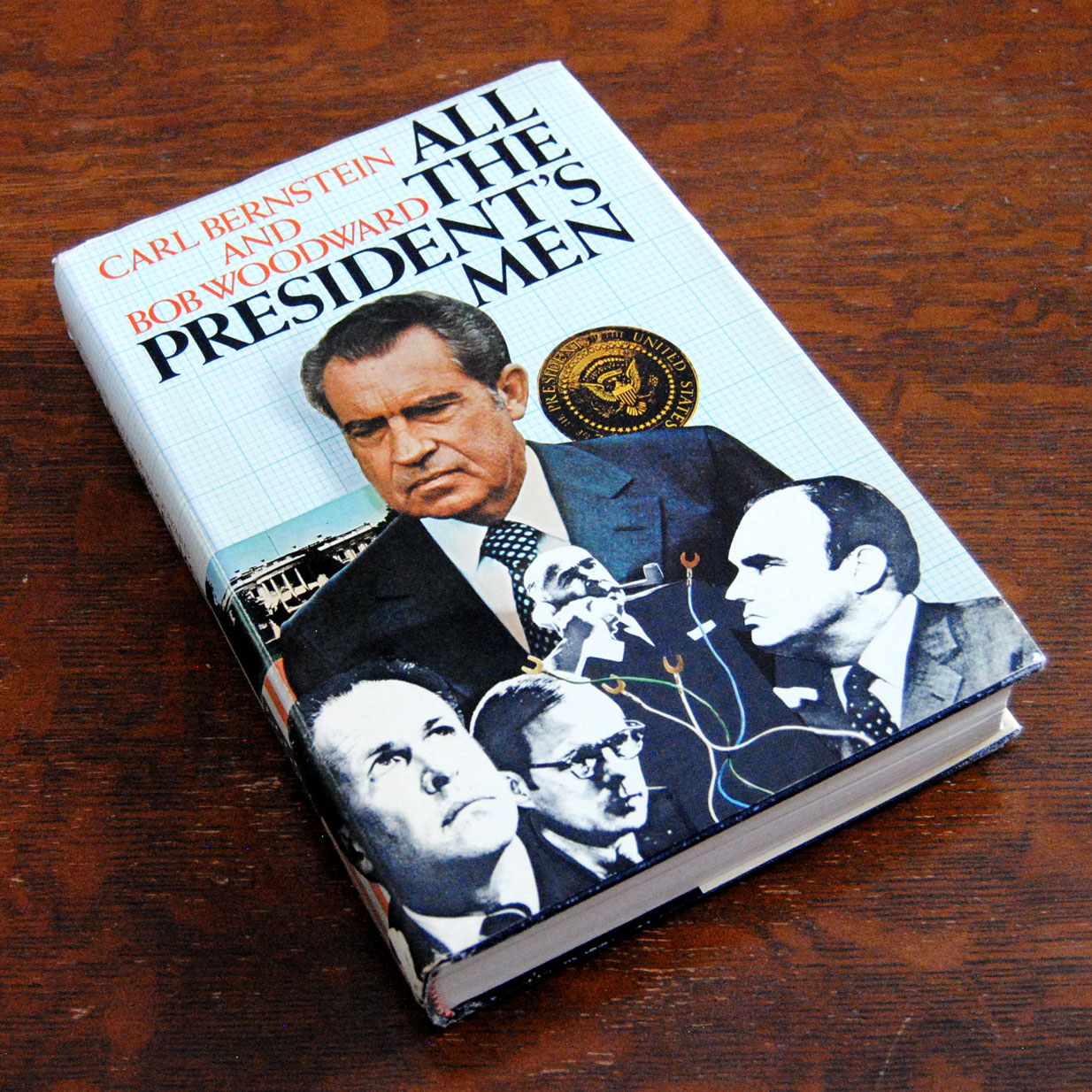
Given my interest in politics and a college minor in journalism, it’s amazing it took me this long to read All the President’s Men by Bob Woodward and Carl Bernstein. But it’s 50 years after its publication, and it is still a fast-paced, well-written masterpiece.
It is a balm in troubling times that despite some of the horrors of the world, great investigative journalism was alive and well, and it could be again.
The inside dust cover boasts, “All America knows about Watergate. Here, for the first time, is the story of how we know.”
And no, I haven’t watched the movie yet. But as always, old-fashioned as I can be, I do like to start with the book where possible. This one is hard to put down.
Perhaps now is a good time to mention that what Woodward and Bernstein were investigating was more than just a single crime. It took on the aura of fighting against what was hiding the truth. What Deep Throat, the pseudonym given to Woodward’s secret informant, called “…the willingness of the President’s men to fight dirty and for keeps, regardless of what effect the slashing might have on the government and the nation.”
Sadly, this now sounds all too familiar.
Despite thinking they were insulated, the web surrounding the President’s men, which the book covers in great detail, was designed to delegate, insulate, and protect. Woodward and Bernstein were the first to pull the strings, eventually knocking the whole web down.
Journalism today isn’t on the same playing field as the one in which Woodward and Bernstein reported on Watergate, for which they received the 1973 Pulitzer Prize. In fact, one could argue that modern attacks on journalism, clickbait headlines with no substance, and the internet, especially social media, have changed the game completely.
There are still some vestiges of ethical investigative journalism, but the media attacks and infighting from network to network, have diluted journalism as a pillar of truth. The truth exists, the problem is that it is just as attacked and lauded the same as the lies, propaganda, and clickbait that surround it.
Reading a paragraph about Woodstein, the portmanteau of Woodward and Bernstein sometimes used in the Washington Post’s offices, reminds me we’ve strayed maybe too far from nuance.
“To those who sat nearby in the newsroom, it was obvious that Woodstein was not always a smoothly operating piece of journalistic machinery. The two fought, often openly. Sometimes they battled for fifteen minutes over a single word or sentence. Nuances were critically important; the emphasis had to be just right. The search for the journalistic mean was frequently conducted at full volume, and it was not uncommon to see one stalk away from the other’s desk. Sooner or later, however (usually later), the story was hammered out.“
In the shrinking newsrooms of today, I don’t get the feeling anyone would take that time, or any time, to fight over the nuance of a sentence, much less a single word.
That’s the hardest thing about reading this book. All the President’s Men is a snapshot in time and a reminder of how far we have gone from the decorum of previous administrations. Having read Marty Baron’s Collision of Power, a book which discusses Trump’s, at best, rocky relationship with the media as a whole, during his first term, and specifically with the Washington Post, it is clear decorum is a suggestion at best.
Trump’s media attacks are foretold in this book, with Nixon’s administration doing as much media discrediting as possible. They denied and denied and denied, until little by little the dam finally broke.
But it wasn’t easy and it wasn’t straight forward. This book starts on June 17, 1972, and ends around Nixon’s January 30, 1974, State of the Union Address. In between is some of the most famous investigative journalism of the last century.
It’s all about how two men, Bob Woodward and Carl Bernstein, chased a story that went cold more than a few times, and continued to chase leads and confirm information. It’s how things were done before the internet and 24-hour news channels. And it’s how things were done with phone calls, meetings, and the occasional movement of a potted plant.
This book is an all-timer. For students of journalism and for those interested in how power corrupts, All the President’s Men is enthralling, even if you do know how it ends before you read the first page. If more true crime books were written this well, I might endeavour to read more of the genre.