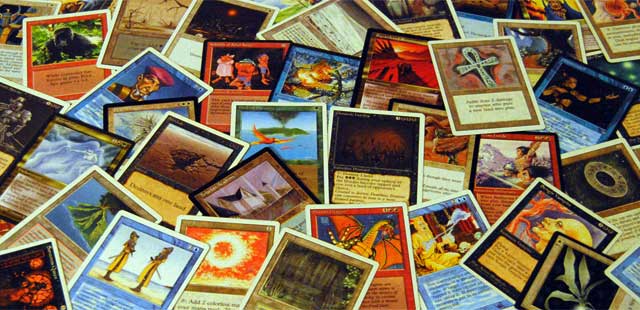
Urza’s Destiny was released on June, 23rd 1999 as the last expansion for the Urza’s Block. It was the first expansion to fully embrace the new rules introduced in Classic Sixth Edition, because it was the first set released since Classic Sixth changed the game of Magic: the Gathering.
He’s written fiction, non-fiction, and essays about music, death, history and pop culture, but now Chuck Klosterman has turned his attention to villains with I Wear the Black Hat: Grappling with Villains (Real and Imagined), a book published on July 9th, 2013 and reprinted in paperback on July 1st, 2014.
Before we get into the book, let’s first look at the definition of the word villain, a noun. According to Merriam-Webster’s online dictionary, Villain is “a character in a story, movie, etc., who does bad things,” “a person who does bad things,” and “someone or something that is blamed for a particular problem or difficulty.”
Almost a decade before Warcraft became synonymous with World of Warcraft (WOW), the juggernaut of massively mutliplayer online role-playing games (MMORPG), and a year before Blizzard would dazzle the world with Diablo, Warcraft II: Tides of Darkness ruled the gaming industry.
The building began in earnest in April 1879, at first with stones from his pocket. It gradually moved to stones in a basket and eventually included a wheelbarrow to move larger stones. It took him 33 years to build the palace, 20 of which were spent on the outer walls alone. From one stone to another along his postal route, he collected them while thinking to himself, “Since Nature is willing to do the sculpture, I will do the masonry and the architecture.”
Resembling more Chronicles and less core set, Classic Sixth Edition was more than just a collection of cards. It was a prophetic look into the future, setting precedence with its changes for the core sets to follow in its near future. The set itself wasn’t very “classic” when it was released on April 28,