
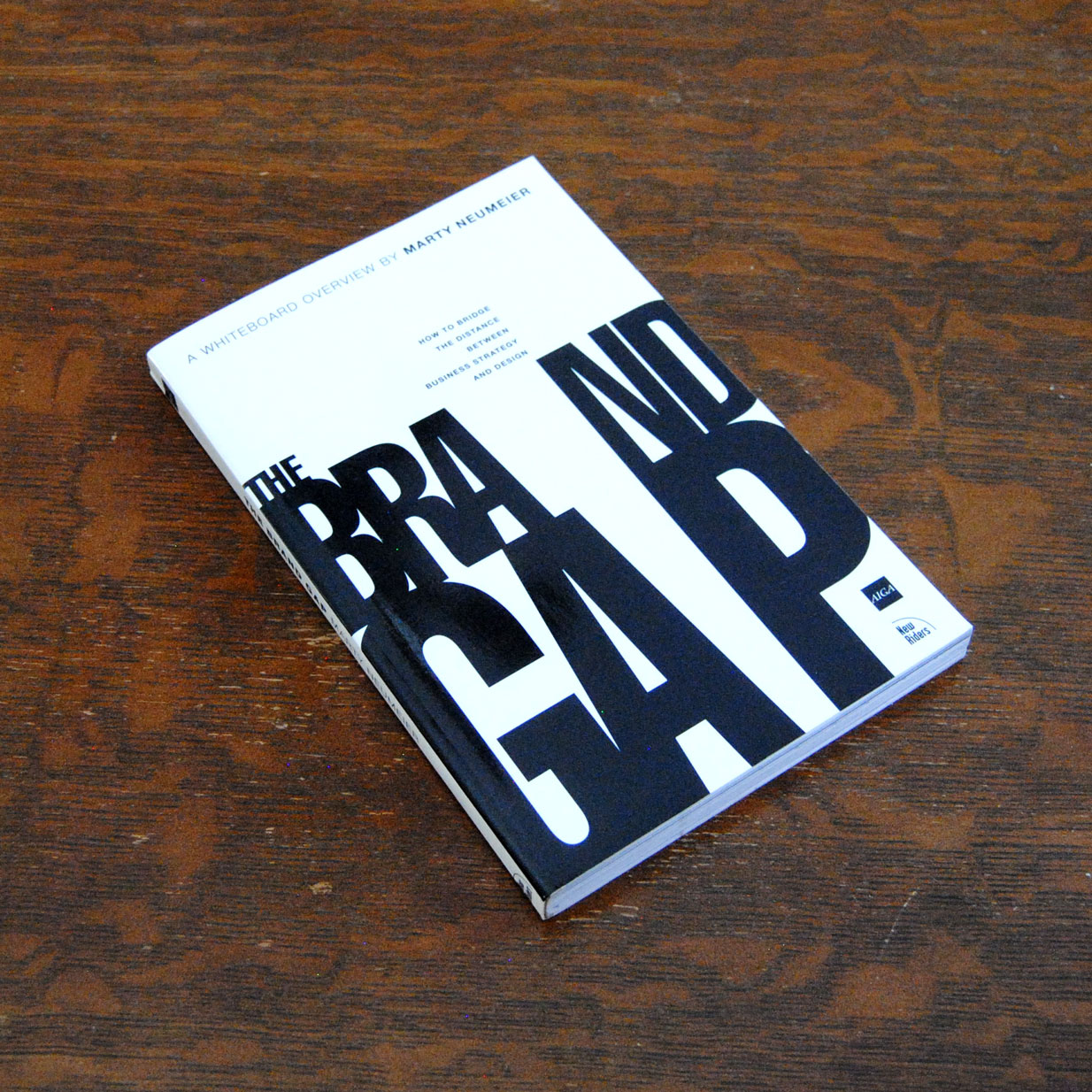
Marty Neumeier attempts to bridge “The Brand Gap,” but does he succeed? Two decades on from its publishing, I think there is more in The Brand Gap that is still relevant than some of the more dated material that’s just fun to reminisce as you read.
The book attempts to explain and educate the reader on “How to bridge the distances between business strategy and design.” And if that subtitle and the book title doesn’t clue you in, he is talking about brand value and how to raise it.
Personally, I think this book is a great litmus test for brands. I found this book to be a thought-provoking, easy read. I understood everything he wrote about. But I’m sure I have professionally encountered people who would see this book as either confusing or unnecessary. I hope you never work for those people.
As Marty defines it, “A brand is a person’s gut feeling about a product, service, or company. It’s a GUT FEELING because we’re all emotional, intuitive beings, despite our best efforts to be rational. It’s a PERSON’S gut feeling, because in the end the brand is defined by individuals, not by companies, markets, or the so-called general public. Each person creates his or her own version of it.”
“Brands can afford to be inconsistent–as long as they don’t abandon their defining attributes.“
And the suggested questions you should answer to find those defining attributes are, “Who are you?” “What do you do?” “Why does it matter?” But you can’t just answer those questions. You have to “demand unambiguous answers.”
So I may attempt that in the future for the Agent Palmer brand!

Otherwise, it’s definitely a corporate gift book designed to start conversations. And, yes, it’s dated! Cingular doesn’t exist anymore. I don’t think United Airlines has used Rhapsody in Blue for a while now, and Marty was technically correct that Amazon took a dive when it moved on from its book focus to its “everything store” mentality, but the statistics he cites in this book would bear out wrong. The dip was temporary and Amazon is a ridiculous success.
But the book maintains relevance decades on with one sentiment: “Let the brand live, breathe, make mistakes, be human. Instead of trying to present a Teflon-smooth surface, project a three-dimensional personality, inconsistencies and all. Brands can afford to be inconsistent–as long as they don’t abandon their defining attributes.”
In the coming onslaught of AI slop, having a real personality has more to do with staff than algorithm. It has more to do with creativity and intuition than prompts or scripts. And for some people, they need to get through most of the book to understand what that statement means. In that regard, if for no other reason, this book remains valuable.
Then again, in my experience the people who need this book the most are the people least likely to read it, even if you gift wrap it for them.
Read the Secret File of technical information and quotes from The Brand Gap.