Commissioned artist for CBS. Aspiring astronaut. Potential vampire.
There’s a lot to learn about graphic designer Ryan Lynn, as you’ll find in the following interrogation, like how his weekends are spent recharging his batteries and how his day job, at 4O1! Creative, provided him his first foray into the world of Agent Palmer.
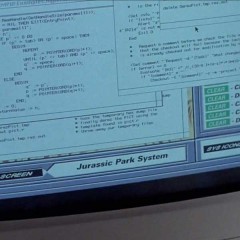
The question started to fester after spotting a Tumblr post entitled “Source Code in TV and Films.” It’s a brilliant concept of taking an in-depth look into the code on computer screens in television shows and movies and finding out what it really is.
The lines of code in SwordFish are from a DES cracking program, Nedry’s screen from Jurassic Park appears to be source code for a SGI UNIX machine, the boot up sequence for the Mark I version of the Iron Man suit in Iron Man written to boot up the suit for Tony Stark’s escape is some butchered C code, but does it have to be? Does it have to hold up?
Beginning with the heart-wrenching bus accident that claimed the life of Cliff Burton and then chronicling the band and its many players through the release of Death Magnetic, Enter Night: A Biography of Metallica by Mick Wall is brilliant.
Who better than Mick Wall, as classic a name in Rock journalism as there is, to chronicle the life and times of one of the biggest bands in the world.
Recently, I stumbled upon an amazing documentary housed in an equally brilliant site: Clouds Over Cuba which is hosted at www.cloudsovercuba.com. It’s been around for a while and was produced by The Martin Agency.
The documentary is an “interactive multimedia documentary” of the Cuban Missile Crisis, narrated by Matthew Modine, conceptualized by The Martin Agency and created by Brian Williams, Wade Alger, Joe Alexander, and Ben Tricklebank on behalf of The JFK Presidential Library.
Heavy Metal was released on Aug. 7, 1981. It was produced on a meager $9.3 million budget, but grossed nearly $20 million dollars during it’s initial theatrical release. Twenty-five years later, after some music industry scuffles about song rights, the film was re-released, as “Louder and Nastier than Ever,” in theaters on March 8, 1996 and later that year was released on VHS and Laserdisc, which sold over a million units. Five years after that in 2011, it was released on Blu-ray.
The film follows closely to the magazine it shares its title with, in that it was a film made up of 10 stories, although only nine were released. The only differentiating factor between the movie and the magazine, is that the movie is tied together with the Loc-Nar, while the magazine stories are not tied together at all in any given issue.