
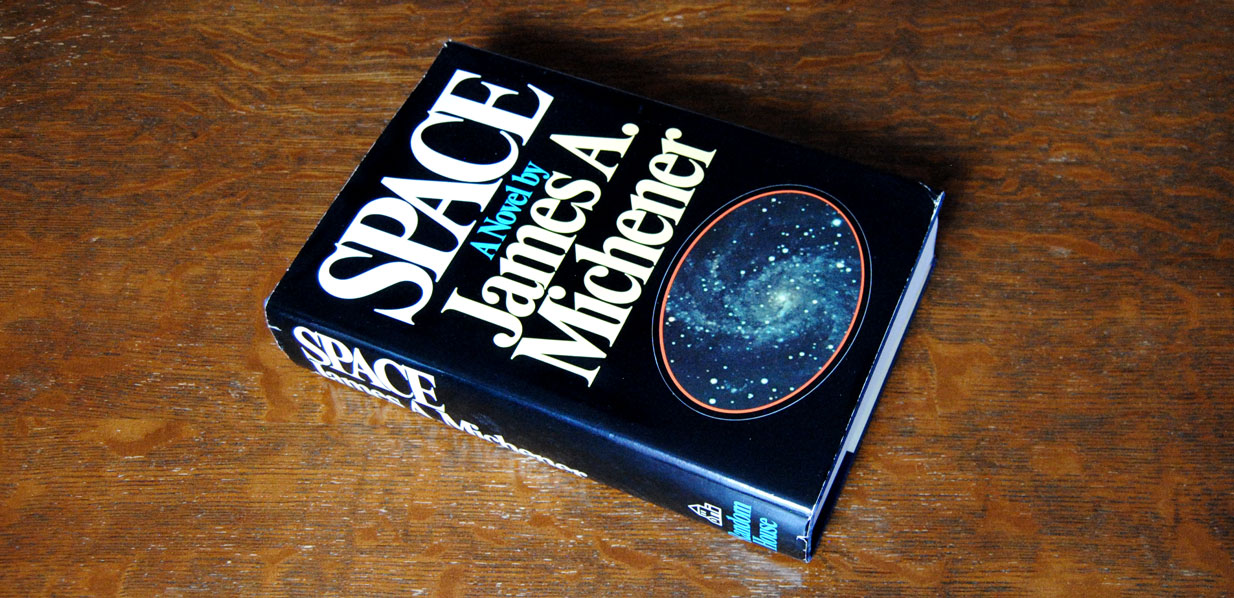
James A Michener’s Space is such a complete work of fiction that it doesn’t just underscore the patriotic heroism of the Space Race. It also displays the media bias of the time towards pristine American heroes and the sad triumph of going to the Moon, only to turn away from science after the accomplishment.
As the preface first states, “This is a novel and to construe it as anything else would be a mistake. The Mott, Grant, Pope and Kolff families are imaginary and are based upon no real prototypes. The Solid Six group of astronauts did not exist, nor was there any Gemini 13 or Apollo 18.” But to go a step further, the inside dust cover ends with, “Space is a compelling narrative, fiction for the most part, but solidly built on the factual and the possible.”
These two things allow Michener to tackle things that would otherwise be harder to address realistically. And I’m talking about things like public funding for scientific research and space exploration, the theoretical and sometimes personal battle between science and engineering, small town politics within a national framework, and much more.
This book also paints a picture with characters outside of the space program. Marriage, children, alcohol, drugs, Vietnam, sexuality, religion, conspiracy theories – this may be a semi-fiction world, but it is NOT two-dimensional.
One of the hallmarks of Space is that in this fictional world, Folks, the magazine with the rights to the Solid Six astronaut corps that two of our main characters belong to, is used to underscore and criticize the way NASA and Life, with their real-world exclusivity, wrote glossy paragraphs over the astronauts and their families. They were made out to be fairy tales and, for the most part, succeeded in pushing that narrative.
Perhaps that’s why Space feels more authentic than anything else I’ve read, except for perhaps Wolfe’s The Right Stuff? I don’t think that the astronaut autobiographies are anything to leave out, but as part of the program, they all seem to protect the program. Most of their dissension comes with what happened after they left the program.
In Space, we don’t have to wait. Pope may be a straight arrow, his Gemini 13 capsulemate Randy Claggett less so, but they both feel less like colored-glossy magazine characters and more like real people.
And then there’s Stanley Mott, a brilliant character and perhaps the heart of the whole book, who as both an engineer and a scientist has to figure out what he is. It’s all evidenced by this exchange when Mott joins NACA, NASA’s predecessor;
Crampton stopped, stiffened, and in the gloom of the great tunnel, said, ‘Scientists are men who dream about doing things. Engineers do them. This was designed by engineers, built by engineers, and is run by engineers. You’re an engineer, young fellow, and you’re to be proud of it.’
‘I’m sorry,’ Mott said.
‘You thought that if an engineer was real good, he became a scientist. It’s the other way around. If you want to be an engineer but find you have ten thumbs, you become a scientist.’
Mind you, I’ll be asking something to this effect to every scientist and engineer I meet for the rest of my life, but that’s for another time.
Michener also dives into money and ignorance along the way, exploring all of the greatest parts of the Space Race to the moon.
When it comes to money, Michener captures the sentiment that there is no scientific exploration without an enemy, at least not when it comes to scientific exploration with public funding. Truth be told, this book succinctly describes why we haven’t been back to the Moon since Apollo and why almost all of Voyager 1 and 2’s greatest triumphs were afterthoughts for the general public.
Tangentially related to that, Space illustrates just how every step forward sometimes has to fight against two steps backwards. Those who are against progress almost always marshall the ignorant to their side.
Much like the way Chesapeake ends with a message strongly in favor of environmental conservatism, Space ends in such a way that makes you decide whose side are you on, almost in a prescient bit of foreboding kind of way. Do you want to be 1776 (simple with a religious foundation) or 1976 (complex with a scientific foundation)? The book heavily implies that there was a movement during America’s 200th birthday to go backwards to that simpler time… Here in the year of our 250th, the same discussion seems to be taking hold.
Now more than ever, Michener’s Space is relevant again. Or perhaps it is just as timeless as ever?
Read the Secret File of technical information and quotes from Space by James A. Michener.